
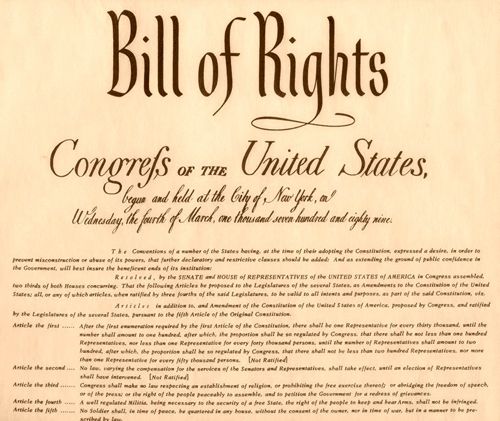
The Bill of Rights is the first ten amendments to the United States Constitution. It was ratified on December 15, 1791, and guarantees certain fundamental rights and liberties to all Americans. The Bill of Rights was drafted in response to concerns that the original Constitution did not adequately protect individual rights from government infringement.
The Bill of Rights covers a wide range of topics, including freedom of religion, speech, press, assembly, and petition; the right to bear arms; the right to a fair trial; and the right to be free from unreasonable searches and seizures. It also establishes the principle that the government cannot deprive any person of life, liberty, or property without due process of law.
The Bill of Rights has been interpreted and applied by the Supreme Court in many cases over the years. Some of the most notable cases include:
- Engle v. Vitale (1962): The Supreme Court ruled that it is unconstitutional for public schools to require students to recite a prayer.
- Gideon v. Wainwright (1963): The Supreme Court ruled that the government must provide an attorney to any indigent defendant who cannot afford one.
- Miranda v. Arizona (1966): The Supreme Court ruled that the police must inform suspects of their rights, including the right to remain silent and the right to an attorney, before interrogating them.
- Roe v. Wade (1973): The Supreme Court ruled that women have a constitutional right to abortion.
- District of Columbia v. Heller (2008): The Supreme Court ruled that the Second Amendment protects an individual's right to possess a firearm unconnected with service in a militia, for traditionally lawful purposes, such as self-defense within the home.
The Bill of Rights is one of the most important documents in American history. It guarantees fundamental rights and liberties to all Americans, and it has been interpreted and applied by the Supreme Court to protect those rights in many important cases.
First Amendment
The First Amendment to the Bill of Rights guarantees freedom of religion, speech, press, assembly, and petition. This means that the government cannot interfere with your right to practice your religion, express your opinions, publish information, or gather together to protest or petition the government.
The First Amendment is one of the most important amendments in the Bill of Rights because it protects the essential freedoms that allow us to participate in a democratic society.
Second Amendment
The Second Amendment to the Bill of Rights guarantees the right to keep and bear arms. This means that the government cannot prevent you from owning or using a gun.
The Second Amendment is a controversial amendment, and there is much debate about its meaning and scope. However, the Supreme Court has ruled that the Second Amendment protects an individual's right to possess a firearm unconnected with service in a militia, for traditionally lawful purposes, such as self-defense within the home.
Third Amendment
The Third Amendment to the Bill of Rights prohibits the government from quartering soldiers in private homes without the consent of the homeowner. This amendment was adopted in response to British military practices during the American Revolution.
The Third Amendment is not as well-known as some of the other amendments in the Bill of Rights, but it is still an important protection against government overreach.
Fourth Amendment
The Fourth Amendment to the Bill of Rights protects against unreasonable searches and seizures. This means that the government cannot search your home or person without a warrant, and the warrant must be based on probable cause.
The Fourth Amendment is an important protection against government intrusion into our private lives. It ensures that we are safe from arbitrary searches and seizures by the police.
Fifth Amendment
The Fifth Amendment to the Bill of Rights guarantees several important rights, including the right to due process of law, the right against self-incrimination, and the right to be free from double jeopardy.
The Fifth Amendment is one of the most important amendments in the Bill of Rights because it protects our fundamental rights in criminal proceedings. The right to due process of law ensures that we are treated fairly and that our rights are respected. The right against self-incrimination prevents the government from forcing us to testify against ourselves. And the right to be free from double jeopardy prevents the government from trying us twice for the same crime.
Sixth Amendment
The Sixth Amendment to the Bill of Rights guarantees several important rights to criminal defendants, including the right to a public trial by an impartial jury, the right to be informed of the charges against them, the right to confront witnesses, the right to compel witnesses to appear in their favor, and the right to have an attorney.
The Sixth Amendment is essential to ensuring that criminal defendants receive a fair trial. It protects the rights of defendants to defend themselves and to be treated fairly by the government.
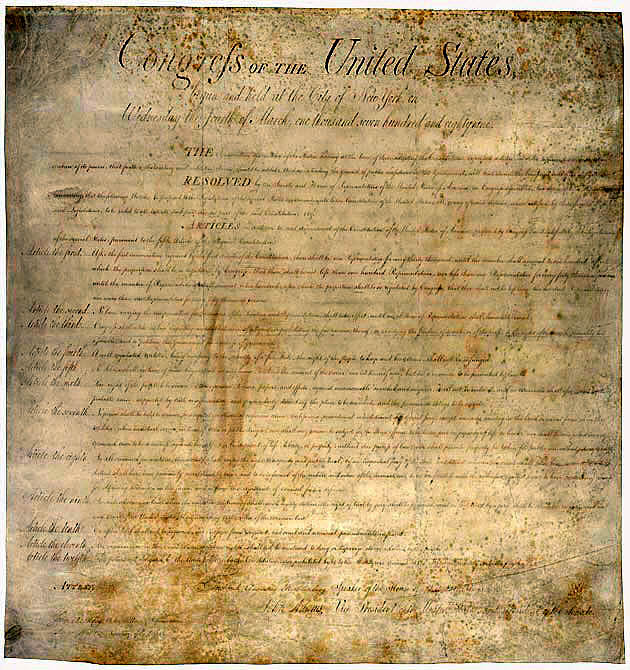
WebThe enumeration in the Constitution, of certain rights, shall not be construed to deny or disparage others retained by the people. Amendment X . The powers not delegated to. WebThe Bill of Rights. Amendment I. Congress shall make no law respecting an establishment of religion, or prohibiting the free exercise thereof; or abridging the.
The United States Bill of Rights – Legends of America
Source: legendsofamerica.com
Bill of Rights: The 1st Ten Amendments - Bill of Rights Institute

Source: billofrightsinstitute.org
Bill of Rights - The Free Speech Center
Source: firstamendment.mtsu.edu
What Is The Text Of The Bill Of Rights, United States Bill of Rights - Complete Text & Audio, 7.48 MB, 05:27, 13,770, Audio Law Library, 2017-02-27T01:36:51.000000Z, 2, The United States Bill of Rights – Legends of America, legendsofamerica.com, 421 x 500, jpg, , 3, what-is-the-text-of-the-bill-of-rights
What Is The Text Of The Bill Of Rights.
Visit audiolawlibrary.com/ for our complete and growing catalog of free audio recordings of famous, infamous & important documents from United States history.
This video includes the text and an audio recording of the Bill of Rights (1st ten amendments of the United States Constitution).
If you enjoyed this, please subscribe to my YouTube channel, where it is my personal mission to create the biggest collection of free audio recordings of famous, infamous, and intriguing laws, Supreme Court cases, and other texts from United States history.
To read the text , click the following link: archives.gov/founding-docs/bill-of-rights-transcript
The United States Bill of Rights – Legends of America
What Is The Text Of The Bill Of Rights, WebThe Bill of Rights. Amendment I. Congress shall make no law respecting an establishment of religion, or prohibiting the free exercise thereof; or abridging the.
United States Bill of Rights - Complete Text & Audio
Source: Youtube.com
United States Constitution · Amendments · Bill of Rights · Complete Text + Audio
Source: Youtube.com
www.archives.gov › founding-docs › bill-of-rightsThe Bill of Rights: A Transcription | National Archives
America's Founding Documents The Bill of Rights: A Transcription Print This Page Note: The following text is a transcription of the enrolled original of the Joint Resolution of Congress proposing the Bill of Rights, which is on permanent display in the Rotunda at the National Archives Museum. The spelling and punctuation reflects the original. What is the theme of the bill of rights.
What is the theme of the bill of rights
What is the theme of the bill of rights What was the bill of rights written on.
What was the bill of rights written on
What was the bill of rights written on What type of text is the bill of rights.
.
What type of text is the bill of rights
What type of text is the bill of rights What is the text of the bill of rights.
.
What is the text of the bill of rights
What is the text of the bill of rights What type of text is the bill of rights.
.
.
.
en.wikipedia.org › wiki › United_States_Bill_of_RightsUnited States Bill of Rights - Wikipedia
The United States Bill of Rights comprises the first ten amendments to the United States Constitution.Proposed following the often bitter 1787–88 debate over the ratification of the Constitution and written to address the objections raised by Anti-Federalists, the Bill of Rights amendments add to the Constitution specific guarantees of personal freedoms and rights, clear limitations on the , .
.
.
.
.
www.britannica.com › topic › Bill-of-Rights-UnitedBill of Rights | Definition, Origins, Contents, & Application ...
Bill of Rights, in the United States, the first 10 amendments to the U.S. Constitution, which were adopted as a single unit on December 15, 1791, and which constitute a collection of mutually reinforcing guarantees of individual rights and of limitations on federal and state governments. .
www.archives.gov › founding-docs › bill-of-rightsThe Bill of Rights: What Does it Say? | National Archives
Español The Bill of Rights The Bill of Rights is the first 10 Amendments to the Constitution. It spells out Americans' rights in relation to their government. It guarantees civil rights and liberties to the individual—like freedom of speech, press, and religion. .
.
www.law.cornell.edu › constitution › billofrightsBill of Rights | U.S. Constitution | US Law | LII / Legal ...
.


Post a Comment