
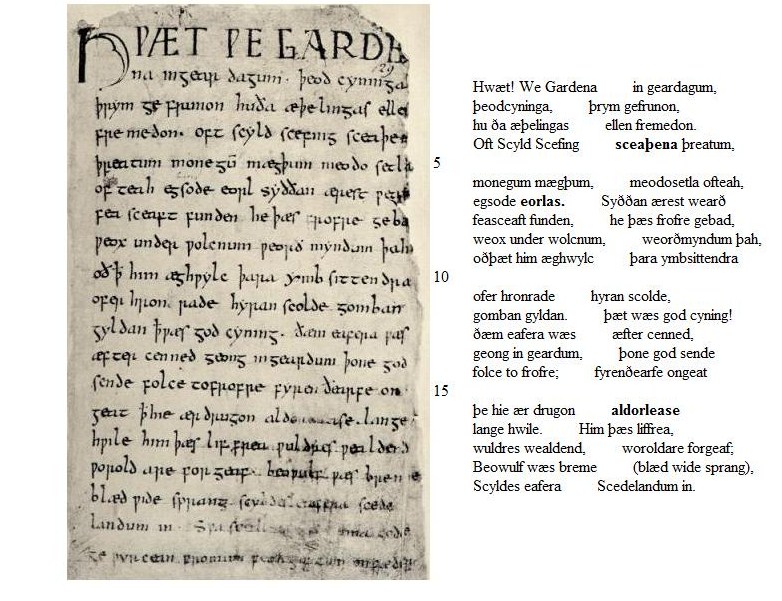
Beowulf is an epic poem written in Old English sometime between the 8th and 11th centuries. It is the oldest surviving major work of English literature, and one of the most important works of Anglo-Saxon culture. The poem tells the story of Beowulf, a Geatish warrior who comes to the aid of Hrothgar, the king of the Danes, whose mead hall, Heorot, has been under attack by a monster named Grendel. Beowulf defeats Grendel, and then Grendel's mother, and is hailed as a hero. Fifty years later, Beowulf returns to Geatland and becomes king. In his old age, he defeats a dragon, but is mortally wounded in the battle.
Beowulf is a complex and multifaceted poem that explores a variety of themes, including heroism, courage, mortality, and the nature of good and evil. It is also a rich source of information about Anglo-Saxon culture and values.
The poem begins with a description of Heorot, a magnificent mead hall built by Hrothgar, the king of the Danes. Heorot is a place of feasting and celebration, but it is also under attack by a monster named Grendel. Grendel is a descendant of Cain, and he is described as a hideous and fearsome creature. He attacks Heorot at night, killing and eating the warriors who are sleeping there.
Hrothgar and his warriors are unable to defeat Grendel, so they call for help from Beowulf, a Geatish warrior who is known for his strength and courage. Beowulf travels to Heorot with a small group of followers, and he challenges Grendel to a single combat.
Beowulf and Grendel fight with their bare hands, and the battle is long and bloody. In the end, Beowulf tears Grendel's arm off, and the creature flees to his lair to die.
The next night, Grendel's mother attacks Heorot, seeking revenge for her son's death. She kills Hrothgar's closest advisor, and then she flees back to her lair.
Beowulf tracks Grendel's mother to her lair, which is located at the bottom of a lake. He dives into the lake and swims to the lair, where he fights Grendel's mother with a sword that he finds at the bottom of the lake. Beowulf kills Grendel's mother, and he returns to Heorot with her head as a trophy.
Beowulf is hailed as a hero by Hrothgar and his warriors. He stays at Heorot for twelve days, and he is given many gifts before he returns to Geatland.
Fifty years later, Beowulf becomes king of Geatland. He rules wisely and justly for many years. However, in his old age, Beowulf is challenged by a dragon that has been terrorizing the countryside.
Beowulf knows that he is too old to defeat the dragon, but he is determined to try. He gathers his warriors and leads them to the dragon's lair. Beowulf fights the dragon with his sword, but the dragon is too powerful. Beowulf is mortally wounded in the battle, but he is able to kill the dragon before he dies.
Beowulf is given a hero's funeral, and his body is buried in a barrow on the coast. Beowulf's death marks the end of the poem.
Beowulf is a complex and multifaceted poem that explores a variety of themes, including:
- Heroism: Beowulf is a classic example of an epic hero. He is strong, courageous, and selfless. He is also humble and wise. Beowulf is willing to risk his own life to help others, and he is always willing to stand up for what is right.
- Courage: Beowulf faces many challenges throughout the poem, but he never gives up. He fights Grendel and Grendel's mother with his bare hands, and he fights the dragon even though he knows that he is too old to win. Beowulf's courage is an inspiration to his followers, and it is one of the reasons why he is such a beloved hero.
- Mortality: Beowulf is a reminder that even the greatest heroes are mortal. He is able to defeat Grendel, Grendel's mother, and the dragon, but he is ultimately killed by the dragon's venom. Beowulf's death is a reminder that even the strongest and bravest among us are not immune to death.
- Good vs. Evil: Beowulf represents the forces of good, while Grendel, Grendel's mother, and the dragon represent the forces of evil. Beowulf's victory over these creatures is a symbolic victory of good over evil.
Webto Beowulf, illustrious in spirit. She greeted the Geat chieftain and gave thanks to God, wordfully wisdom-fast, so that her wish should come true, that she could anticipate. WebBeowulf is the longest epic poem in Old English, the language spoken in Anglo-Saxon England before the Norman Conquest. More than 3,000 lines long, Beowulf relates the. WebBeowulf. Table of Contents. Beowulf - Epic Poem, Old English, Hero: Beowulf belongs metrically, stylistically, and thematically to a heroic tradition grounded in Germanic. WebBeowulf (Wackerbarth), translated by Athanasius Diedrich Wackerbarth (1849) IA. Beowulf (Hall), translated by Lesslie Hall (1892), based on the Heyne-Socin. WebBeowulf is probably about 1000 years old although the dates of its composition and its recording in writing are unknown. Beowulf probably was part of the oral tradition for a.
Beowulf, the text - Talk about English
Source: talkaboutenglish.weebly.com
Beowulf (poem) - Tolkien Gateway

Source: tolkiengateway.net
Beowulf | The British Library

Source: bl.uk
What Is The Text About Beowulf, Beowulf - Poem Summary, 9.41 MB, 06:51, 189,773, GradeSaver, 2022-04-21T14:16:49.000000Z, 2, Beowulf, the text - Talk about English, talkaboutenglish.weebly.com, 601 x 782, jpg, , 3, what-is-the-text-about-beowulf
What Is The Text About Beowulf. Webwhen the ruler of Geats in rush of battle, lord of his folk, in the Frisian land, son of Hrethel, by sword-draughts died, by brands down-beaten. Thence Beowulf fled. through strength of himself and his swimming power, though alone, and his arms were laden with thirty.. WebThe present work is a modest effort to reproduce approximately, in modern measures, the venerable epic, Beowulf. Approximately, I repeat; for a very close.
Visit us at gradesaver.com/beowulf/study-guide/video-beowulf to read the full video transcript and our study guide for this classic poem, which includes a full list of characters, themes, and much more.
Beowulf is the first surviving epic written in the English language, though its author remains mysterious. The circumstances of the poem's creation are hotly debated by scholars. Many also believe the story was conveyed orally before it took the form of a manuscript, since the only existing copy dates back to the late tenth century.
Originally composed in Old English, the epic draws from early Germanic legend and is set in pagan Scandinavia. It recounts the saga of Beowulf, a Geat warrior who defends the Danish kingdom, and then his own, from various bloodthirsty monsters.
The poem opens on Hrothgar, the King of the Danes, who plans to celebrate his reign by building a grand hall called Heorot. When the hall is finished, Hrothgar holds a large feast that attracts the attention of Grendel, a monster descended from the biblical Cain. Grendel attacks during the night, leaving Hrothgar and his thanes to discover the bloodshed the next morning. This marks the beginning of Grendel's reign of terror.
Twelve years pass, and news of Grendel's campaign against the Danes spreads to another tribe, the Geats. Beowulf, a Geat thane, decides to help the Danes, sailing to Denmark with his best warriors. King Hrothgar gladly accepts Beowulf's help.
To honor Beowulf's arrival, Hrothgar holds another feast at Heorot. During the celebration, a thane named Unferth engages Beowulf in a boasting match, accusing him of losing a swimming contest. But Beowulf corrects him with a story of his heroic victory in the contest, prompting the Danish queen, Wealhtheow, to award him the ceremonial mead cup. Beowulf tells the queen he will either kill Grendel or be killed. Hrothgar is moved and promises Beowulf all of his gold if Beowulf should defeat the monster.
Beowulf and his warriors spend the night in Heorot. Sure enough, Grendel arrives, gobbling up one of Beowulf's men. Beowulf fights Grendel unarmed, managing to catch the monster's arm in a death grip. Writhing in pain, the monster tears away, leaving his arm in Beowulf's grasp. Grendel slinks off to his lair, where he dies.
Overjoyed at the defeat of Grendel, the Danes nail the creature's arm to the walls of Heorot as a trophy, bathing Beowulf and his men in riches. They hold another feast for Beowulf, where Hrothgar's minstrel composes songs honoring Beowulf as the greatest hero in Danish history. However, once the revelers are asleep, Grendel's mother arrives, seeking revenge. She manages to snatch one of Hrothgar's counselors and retreats to her lair.
Hrothgar points Beowulf in the direction of the monsters' lair, and Beowulf persuades the king to accompany him there. Upon arriving, Beowulf takes a sword from Unferth and dives into a deep lake. When he reaches the bottom, Beowulf finds Grendel's mother, waiting to attack. He uses Unferth's sword but finds it useless against the creature and wrestles with the monster until he spots another sword, which he uses to slice off Grendel's mother's head. Before leaving, he notices Grendel's dead body and cuts off his head too.
Meanwhile, the Danes have given up all hope of Beowulf's safe return. But to their shock, Beowulf surfaces carrying Grendel's head and the hilt of his sword, which melted in the heat of Grendel's blood. The men bring Beowulf back to Heorot, where yet another celebration takes place. Before returning home to Geatland, Beowulf promises an alliance with Hrothgar forever, which the king gratefully reciprocates.
Beowulf and his men return home, regaling the Geat king and queen, Hygelac and Hygd, with tales of their victory. Impressed with Beowulf's bravery, Hygelac gives him half the kingdom. When Hygelac is killed in battle, Beowulf becomes king of the Geats.
In the fiftieth year of Beowulf's reign, a new monster begins to terrorize his kingdom: a fire-breathing dragon seeking revenge on a Geat servant who stole a golden cup from its lair, which houses an ancient treasure trove. Finding the cup missing, the dragon goes on a fiery rampage, destroying Beowulf's great hall.
With a heavy heart, Beowulf decides to face the dragon alone, knowing this battle may be his last. The servant who stole the cup leads him to the dragon's lair, where Beowulf attempts to defeat the beast but is outmatched. All of his warriors flee except one, Wiglaf, who vows to stay by Beowulf's side. Together, they face the dragon. But just as Beowulf manages to behead the monster, the dragon bites him, sending a lethal poison through his body.
With his dying breath, Beowulf tells Wiglaf that he should inherit the dragon's treasure. Wiglaf returns to the Geats with the news of their king's death, declaring that no one should inherit the treasure and scolding the warriors who fled for their cowardice.
Beowulf, the text - Talk about English
What Is The Text About Beowulf, WebBeowulf. Table of Contents. Beowulf - Epic Poem, Old English, Hero: Beowulf belongs metrically, stylistically, and thematically to a heroic tradition grounded in Germanic. WebBeowulf (Wackerbarth), translated by Athanasius Diedrich Wackerbarth (1849) IA. Beowulf (Hall), translated by Lesslie Hall (1892), based on the Heyne-Socin. WebBeowulf is probably about 1000 years old although the dates of its composition and its recording in writing are unknown. Beowulf probably was part of the oral tradition for a.
What is the moral of beowulf
What is the moral of beowulf What is the main message of beowulf.
What is the main message of beowulf
What is the main message of beowulf What is the message of beowulf.
What is the message of beowulf
What is the message of beowulf What is the text structure of beowulf.
.
What is the text structure of beowulf
What is the text structure of beowulf What is the text about beowulf.
.
What is the text about beowulf
What is the text about beowulf What is the text structure of beowulf.
www.sparknotes.com › lit › beowulfBeowulf: Study Guide | SparkNotes
Overview Beowulf, an epic poem of unknown authorship, was likely composed between the 8th and 11th centuries. It stands as a cornerstone of Anglo-Saxon literature, embodying the heroic spirit of the time. .
www.poetryfoundation.org › poems › 50114Beowulf (trans. by Francis B. Gummere) - Poetry Foundation
a son in his halls, whom heaven sent to favor the folk, feeling their woe that erst they had lacked an earl for leader so long a while; the Lord endowed him, the Wielder of Wonder, with world's renown. Famed was this Beowulf: far flew the boast of him, son of Scyld, in the Scandian lands. So becomes it a youth to quit him well .
.
.
.
.
.
.
www.sparknotes.com › lit › beowulfBeowulf: Full Poem Summary | SparkNotes
Full Poem Summary Previous Next King Hrothgar of Denmark, a descendant of the great king Shield Sheafson, enjoys a prosperous and successful reign. He builds a great mead-hall, called Heorot, where his warriors can gather to drink, receive gifts from their lord, and listen to stories sung by the scops, or bards. .
en.wikipedia.org › wiki › BeowulfBeowulf - Wikipedia
Beowulf ( / ˈbeɪəwʊlf /; [1] Old English: Bēowulf [ˈbeːowuɫf]) is an Old English epic poem in the tradition of Germanic heroic legend consisting of 3,182 alliterative lines. It is one of the most important and most often translated works of Old English literature. What is the main point of beowulf.
What is the main point of beowulf
What is the main point of beowulf What is the main theme of beowulf.
What is the main theme of beowulf www.britannica.com › topic › BeowulfBeowulf | Summary, Poem, Characters, Monster, Analysis ...
What is the main theme of beowulf After learning of the Danes' trouble, young Beowulf, a prince of the Geats in what is now southern Sweden, arrives with a small band of retainers and offers to rid Heorot of its monster. Hrothgar is astonished at the little-known hero's daring but welcomes him. After an evening of feasting, much courtesy, and some discourtesy—at one point , What is the moral of beowulf.


Post a Comment