
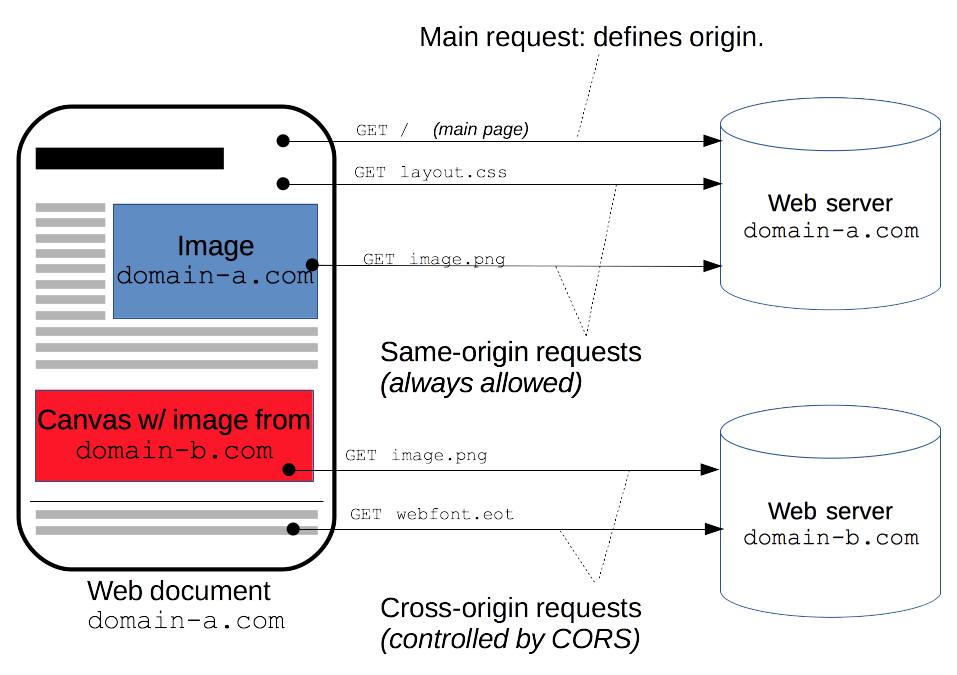
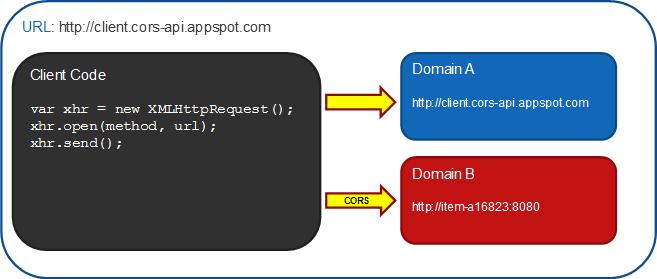
Cross-Origin Resource Sharing (CORS) is a mechanism that allows restricted resources on a web page to be accessed from another domain outside the domain from which the first resource was served. A web page may freely embed cross-origin images, stylesheets, scripts, iframes, and videos. Certain "cross-domain" requests, notably Ajax requests, are forbidden by default by the same-origin security policy. CORS defines a way in which a browser and server can interact to determine whether it is safe to allow the cross-origin request.
CORS is implemented using HTTP headers. When a browser makes a cross-origin request, it includes additional HTTP headers in the request. These headers specify the origin of the request and the resources that the request is trying to access. The server then responds with its own HTTP headers, which indicate whether the request is allowed.
If the request is allowed, the browser will proceed with the request. If the request is denied, the browser will block the request and display an error message.
Why is CORS important?
CORS is important because it allows web developers to build applications that can access resources from different domains. This can be useful for a variety of reasons, such as:
- To use third-party APIs
- To load resources from a content delivery network (CDN)
- To develop single-page applications (SPAs) that can access data from multiple sources
How does CORS work?
CORS works by using a preflight request. A preflight request is a special type of HTTP request that is used to determine whether the server is willing to allow a cross-origin request.
When a browser makes a cross-origin request, it first sends a preflight request to the server. The preflight request includes the following information:
- The HTTP method of the original request
- The request headers that will be used in the original request
- The resources that the original request is trying to access
The server then responds with a preflight response. The preflight response indicates whether the server is willing to allow the original request. If the server is willing to allow the original request, the preflight response will include the following information:
- The HTTP methods that are allowed for the original request
- The request headers that are allowed for the original request
- The maximum time that the browser can cache the preflight response
If the server is not willing to allow the original request, the preflight response will include an error message.
Once the browser has received the preflight response, it will proceed with the original request if the server has allowed it. If the server has not allowed the original request, the browser will block the request and display an error message.
CORS headers
There are several HTTP headers that are used for CORS. The most important headers are:
- Origin: This header specifies the origin of the request.
- Access-Control-Allow-Origin: This header specifies the origins that are allowed to access the resource.
- Access-Control-Allow-Methods: This header specifies the HTTP methods that are allowed for the request.
- Access-Control-Allow-Headers: This header specifies the request headers that are allowed for the request.
Example CORS request
The following example shows a CORS request:
GET /api/users HTTP/1.1 Origin: https://example.com The Origin header in this request specifies that the request is coming from the domain https://example.com.
The following example shows a CORS response:
HTTP/1.1 200 OK Access-Control-Allow-Origin: * Access-Control-Allow-Methods: GET The Access-Control-Allow-Origin header in this response specifies that the resource can be accessed from any origin. The Access-Control-Allow-Methods header specifies that the GET HTTP method is allowed for the resource.
CORS troubleshooting
If you are having problems with CORS, there are a few things you can check:
- Make sure that the
Originheader is included in the request. - Make sure that the
Access-Control-Allow-Originheader is included in the response. - Make sure that the
Access-Control-Allow-Methodsheader includes the HTTP method that you are using in the request. - Make sure that the
Access-Control-Allow-Headersheader includes the request headers that you are using in the request.
If you are still having problems, you can use the Chrome DevTools to inspect the CORS headers that are being sent and received.
Conclusion
CORS is a powerful mechanism that allows web developers to build applications that can access resources from different domains. By understanding how CORS works, you can avoid common problems and build
WebCORS requests may only use the HTTP or HTTPS URL scheme, but the URL specified by the request is of a different type. This often occurs if the URL specifies a. WebCORS is a method for allowing request permissions to access a certain resource by utilising additional HTTP headers. In addition, with an HTTP OPTIONS. WebNode.js CORS middleware. Latest version: 2.8.5, last published: 5 years ago. Start using cors in your project by running `npm i cors`. There are 13334 other projects in the npm.
CORS in 100 Seconds

Source: Youtube.com
CORS, Preflight Request, OPTIONS Method | Access Control Allow Origin Error Explained

Source: Youtube.com
What Is A Cors Request, CORS in 100 Seconds, 3.46 MB, 02:31, 459,523, Fireship, 2021-03-29T15:17:54.000000Z, 2, Cross-Origin Resource Sharing (CORS) - HTTP | MDN, 643 x 925, jpg, , 3, what-is-a-cors-request
What Is A Cors Request. WebHere's how you can debug CORS requests using curl. Sending a regular CORS request using cUrl: curl -H "Origin: http://example.com" --verbose \. Webtest-cors.org. Use this page to test CORS requests. You can either send the CORS request to a remote server (to test if CORS is supported), or send the CORS request to a test.
Cross-Origin Resource Sharing or CORS is a mechanism that allows browsers to request data from 3rd party URLs (or origins) and is a common pain point for web developers. Learn the basics of CORS in 100 seconds.
Full Tutorials
Use CORS in Firebase Cloud Functions fireship.io/lessons/secure-firebase-cloud-functions/
Helpful CORS Resources
web.dev/cross-origin-resource-sharing/
developer.mozilla.org/en-US/docs/Web/HTTP/CORS
#webdev #js #100SecondsOfCode
Install the quiz app 🤓
iOS itunes.apple.com/us/app/fireship/id1462592372?mt=8
Android play.google.com/store/apps/details?id=io.fireship.quizapp
Upgrade to Fireship PRO at fireship.io/pro
Use code lORhwXd2 for 25% off your first payment.
My VS Code Theme
- Atom One Dark
- vscode-icons
- Fira Code Font
What Is A Cors Request, WebCORS requests may only use the HTTP or HTTPS URL scheme, but the URL specified by the request is of a different type. This often occurs if the URL specifies a. WebCORS is a method for allowing request permissions to access a certain resource by utilising additional HTTP headers. In addition, with an HTTP OPTIONS. WebNode.js CORS middleware. Latest version: 2.8.5, last published: 5 years ago. Start using cors in your project by running `npm i cors`. There are 13334 other projects in the npm.
Cross-Origin Resource Sharing (CORS) - HTTP | MDN - Source: MDN Web Docs - Mozilla

What is CORS? - Cross-Origin Resource Sharing Explained - AWS - Source: aws.amazon.com
Cross-Origin Resource Sharing - Source: docs.oracle.com
What is options request in postman developer.mozilla.org › en-US › docsCross-Origin Resource Sharing (CORS) - HTTP | MDN - MDN Web Docs
What is options request in postman Cross-Origin Resource Sharing (CORS) is an HTTP-header based mechanism that allows a server to indicate any origins (domain, scheme, or port) other than its own from which a browser should permit loading resources. CORS also relies on a mechanism by which browsers make a "preflight" request to the server hosting the cross-origin resource, in order to check that the server will permit the , What is invalid cors request.
What is invalid cors request
What is invalid cors request What is a cors preflight request.
What is a cors preflight request
What is a cors preflight request What is a options request.
.
What is a options request
What is a options request What is a cors request.
.
What is a cors request
What is a cors request What is a options request.
en.wikipedia.org › wiki › Cross-origin_resource_sharingCross-origin resource sharing - Wikipedia
Cross-origin resource sharing ( CORS) is a mechanism that allows a web page to access restricted resources from a server on a domain different than the domain that served the web page. A web page may freely embed cross-origin images, stylesheets, scripts, iframes, and videos. Certain "cross-domain" requests, notably Ajax requests, are forbidden , .
.
.
reflectoring.io › complete-guide-to-corsComplete Guide to CORS - Reflectoring
The CORS protocol consists of a set of headers that indicates whether a response can be shared cross-origin. For requests that are more involved than what is possible with HTML's form element, a CORS-preflight request is performed, to ensure the request's current URL supports the CORS protocol. .
.
.
.
.
blog.postman.com › what-is-corsWhat Is CORS? | Postman Blog
Gbadebo Bello. December 21, 2023. CORS, which stands for "Cross-Origin Resource Sharing," is a security standard that enables servers to indicate the origins from which browsers are allowed to request resources. It was created to refine the same-origin policy (SOP), which browsers use to prevent malicious applications from accessing , What is cors and how does it work.
What is cors and how does it work portswigger.net › web-security › corsWhat is CORS (cross-origin resource sharing)? Tutorial ...
What is cors and how does it work an attacker can directly forge a request from any trusted origin. Therefore, web servers should continue to apply protections over sensitive data, such as authentication and session management, in addition to properly configured CORS. Cors request example.
Cors request example aws.amazon.com › what-is › cross-origin-resource-sharingWhat is CORS? - Cross-Origin Resource Sharing Explained - AWS
Cors request example In HTTP, request methods are the data operations the client wants the server to perform. Common HTTP methods include GET, POST, PUT, and DELETE. In a regular cross-origin resource sharing (CORS) interaction, the browser sends the request and access control headers at the same time. These are usually GET data requests and are considered low-risk. How to make a cors request.
How to make a cors request auth0.com › blog › cors-tutorial-a-guide-to-crossCORS Tutorial: A Guide to Cross-Origin Resource Sharing - Auth0
How to make a cors request Cross-Origin Resource Sharing (CORS) is a protocol that enables scripts running on a browser client to interact with resources from a different origin. This is useful because, thanks to the same-origin policy followed by XMLHttpRequest and fetch, JavaScript can only make calls to URLs that live on the same origin as the location where the , What is options request in postman.


 is a mechanism that allows restricted resources on a web page to be accessed from another domain outsid...)
Post a Comment