

When you write, it’s important to have a purpose in mind. What do you want your reader to learn, feel, or do? Once you know your purpose, you can tailor your writing to achieve it.
There are four main purposes of writing:
- To inform: To provide the reader with information about a topic.
- To persuade: To convince the reader to take a certain action or believe a certain way.
- To entertain: To amuse or entertain the reader.
- To express oneself: To share one’s thoughts and feelings with the reader.
Examples of texts with different purposes:
- To inform: News articles, textbooks, instruction manuals, how-to guides, recipes, etc.
- To persuade: Advertisements, political speeches, opinion pieces, sales letters, etc.
- To entertain: Novels, short stories, poems, plays, movies, TV shows, etc.
- To express oneself: Diaries, journals, letters, blogs, social media posts, etc.
How to determine the purpose of a text:
There are a few clues you can look for to determine the purpose of a text:
- The title: The title can often give you a good indication of the text’s purpose. For example, a news article titled "New Study Finds That Eating Broccoli Can Reduce Your Risk of Cancer" is likely to be informative.
- The first sentence: The first sentence of a text often states the text’s main purpose. For example, a persuasive essay might start with a sentence like "In this essay, I will argue that the government should ban the sale of junk food to children."
- The tone: The tone of a text can also give you clues about its purpose. For example, a humorous text is likely to be meant to entertain, while a serious text is more likely to be meant to inform or persuade.
How to write for a specific purpose:
Once you know the purpose of your writing, you can tailor your writing to achieve it. Here are a few tips:
- To inform: Be clear and concise in your writing. Use facts and statistics to support your claims. Avoid using jargon or technical language that your reader may not understand.
- To persuade: Use strong evidence to support your argument. Be objective and avoid using emotional appeals.
- To entertain: Use vivid language and imagery to bring your writing to life. Create characters and plots that your reader will care about.
- To express oneself: Be honest and authentic in your writing. Share your thoughts and feelings in a way that is meaningful to you.
Conclusion:
No matter what your purpose is, it is important to write clearly and effectively. By following the tips above, you can write texts that will achieve your desired outcome.
Examples of texts with multiple purposes
Many texts have multiple purposes. For example, a news article might be informative and persuasive at the same time. It might inform the reader about a new study, but it might also be trying to persuade the reader to support a certain cause.
Another example is a novel. A novel might be meant to entertain the reader, but it might also be trying to inform the reader about a certain topic or persuade the reader to think about a certain issue in a new way.
How to analyze the purpose of a text
When you are reading a text, it is important to try to identify the author’s purpose. This will help you to understand the text better and to critically evaluate its content.
Here are a few questions you can ask yourself when analyzing the purpose of a text:
- What is the main topic of the text?
- What information does the author provide about the topic?
- What does the author want the reader to learn, feel, or do?
- What evidence does the author use to support their claims?
- What is the author’s tone?
- Does the text have a clear bias?
By asking yourself these questions, you can better understand the author’s purpose and the overall message of the text.
Tips for writing effective texts
When you are writing a text, it is important to keep your purpose in mind at all times. This will help you to stay focused and to write a text that is clear, concise, and effective.
Here are a few tips for writing effective texts:
- Know your audience: Who are you writing for? What are their interests and needs? Keep your audience in mind when choosing your topic, writing style, and tone.
- Have a clear purpose: What do you want your reader to learn, feel, or do? Once you know your purpose, you can tailor your writing to achieve it.
- Be clear and concise: Avoid using jargon or technical language that your reader may not understand
Webabout a text. genre In writing, the kind of text a piece of writing is, relating to its purposes, conventions, and form. length In post-secondary education, writing length varies. WebAudience, purpose and form are key to all writing and all combine to influence the language we use. Think about each when you’re writing or analysing a text. WebA writer has an aim when writing a text – they want to have an effect on their reader. A text can have many purposes. Some examples are to: entertain – to amuse the reader or…
1. what is the purpose of each text?2. why does the writer write each text?3. what tenses are used in – Brainly.co.id
Source: brainly.co.id
Teaching Students The Many Purposes of Writing
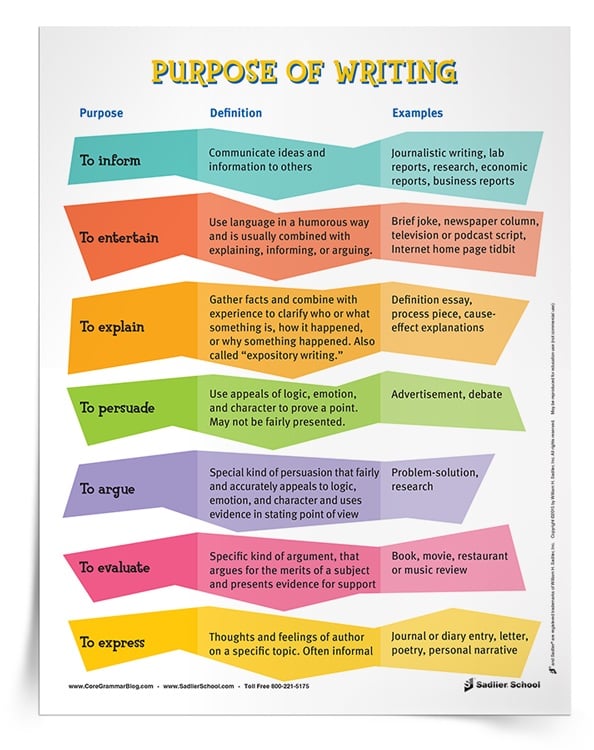
Source: sadlier.com
Find out all you need to know about determining, analysing and choosing an
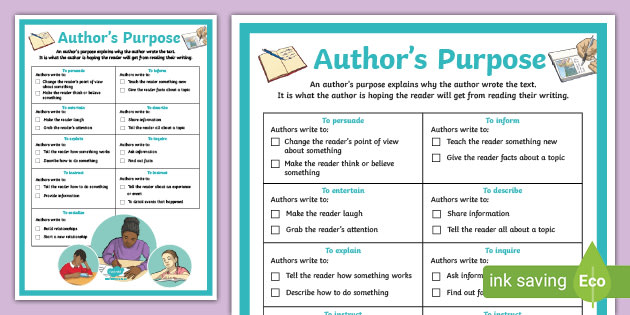
Source: twinkl.co.uk
What Is The Purpose Of Writing Each Text, Purpose: What's Writing For, Anyway | Rhetoric & Composition | Study Hall, 15.52 MB, 11:18, 9,817, Study Hall , 2022-08-22T19:00:25.000000Z, 2, 1. what is the purpose of each text?2. why does the writer write each text?3. what tenses are used in – Brainly.co.id, brainly.co.id, 857 x 764, jpg, , 3, what-is-the-purpose-of-writing-each-text
What Is The Purpose Of Writing Each Text. WebDetermine how genre conventions for structure, paragraphs, tone, and mechanics vary. Identify common formats and design features for different kinds of text. Read and write.
You’re already learning about writing and composition — why not get credit for it link.gostudyhall.com/rhetoric1
Before we start writing, we need to know who our writing is for and what we want it to accomplish. Writing is a useful tool, but it has to be adjusted to fit the purpose a piece has. In this episode, Dr. Emily Zarka discusses different forms of writing and what purposes they serve.
__________________________________________________________________________
Now you can take top-tier college courses with Study Hall! Study Hall videos are available to watch at no cost, and first-year courses are $25 to sign-up and begin coursework. Once you’re satisfied with your grade, receive credit for only $400. Sign up at link.gostudyhall.com/rhetoric1
Follow us on socials!
Twitter: twitter.com/gostudyhall
Instagram: Instagram.com/GoStudyHall
Facebook: facebook.com/GoStudyHall __________________________________________________________________________
Chapters:
0:00 – Introduction
1:25 – Understanding writing goals and purposes
1:55 – Writing as communication
4:31 – Writing to persuade
5:29 – Writing as reflection
7:22 – What is process writing?
10:04 – Conclusion
__________________________________________________________________________
#writing #purpose #WritingTips #Rhetoric #Composition #StudyHall
1. what is the purpose of each text?2. why does the writer write each text?3. what tenses are used in – Brainly.co.id
Purpose: What's Writing For, Anyway | Rhetoric & Composition | Study Hall
Source: Youtube.com
Why Do Writers Write: Understanding the Purpose for Writing (Virtual Tour)

Source: Youtube.com
Text structure and purpose | Lesson (article) | Khan Academy
Instead of just what a text says, these questions dig into why and how the text says it. Since these questions might ask about purpose or structure, let’s look at each in turn. Purpose is the why behind the passage. Why did the author write it? What did they want to accomplish? .
.
The Author’s Purpose: Ultimate Guide for Teachers and Students
A complete guide to the Author’s purpose for students and teachers; persuade, inform or entertain. Including Author’s purpose definition, anchor charts .
IRIS | Page 3: Elements of the Writing Process
Students who struggle with writing generally do not plan ahead; rather, they compose their text as they write. During the planning process, students should ask themselves who their readers will be and what the essay’s purpose is. Planning ahead helps students to form more complete thoughts , .
Understanding the purpose of a text Introduction
Cookies help us to give you a good experience on Wales Essential Skills Toolkit. By continuing, you agree to our use of cookies. Mae cwcis yn ein helpu ni i roi profiad da i chi wrth ddefnyddio Pecyn Cymorth Sgiliau Hanfodol Cymru. O barhau i ddefnyddio’r wefan, rydych yn cytuno i’n defnydd o gwcis. .
How do I determine the purpose of my writing? – FAQS
The first question you ask yourself when you begin writing should be, “What is my goal/purpose for writing?” Understanding your purpose is critical when writing for any course because it can influence your decisions about content, emphasis, organization, style and tone · Your purpose for writing , .
Text Types and Different Styles of Writing: The Complete Guide
Learn to write a variety of text types in the classroom. Different types of writing styles and genres for students and teachers. Resources for students and teachers. .
Purposes – Purdue OWL® – Purdue University
It is the varied purposes of a rhetorical situation that determine how an author communicates a text and how audiences receive a text. Rhetorical situations rarely have only one purpose. Authors and audiences tend to bring their own purposes (and often multiple purposes each) to a rhetorical , .
.
Main Idea, Purpose, & Audience | College Reading and Writing Who comprises the author’s audience and what cues can you use to determine that audience? , The author is writing to an audience of readers who are interested in nature and conservation. If you look on the Orion website and read the “About” section on Mission and History, you’ll see that this publication started as a magazine about nature and grew from there. Based on reading the text… .
1.4 The purpose of texts – The Open University
This free course, Everyday English 1, will develop and improve your essential speaking and listening, reading and writing skills for work, study and everyday life. .
Understanding Your Purpose – The WAC Clearinghouse
While the writer may have intended one thing, the text actually does another, according to its readers. Instructors often state the purpose of a writing assignment on the assignment sheet. By carefully examining what it is you are asked to do, you can determine what your writing’s purpose is. .
1. what is the purpose of each text? 2. why does the writer write each text? 3. what tenses are used…. Question from @Keziahhh
Sekolah Menengah Pertama – B. inggris .
Understanding the Four Major Purposes for Writing
The root page of this site – sites.newpaltz.edu – is not in use. See other New Paltz sites like www.newpaltz.edu, or sites.newpaltz.edu/news for more information · Please go to Appearance → Widgets and add some widgets to your sidebar .
Purpose – Purpose and audience – AQA – GCSE English Language Revision – AQA – BBC Bitesize
to inform but also to persuade, if the article is showing a particular opinion towards , .
Evaluating the Author’s Purpose in a Given Text: TEAS
Guide to help understand and demonstrate Evaluating the Author’s Purpose in a Given Text within the TEAS test. .
Different types of writing – text types
English help pages: Different types of writing – text types .
AUTHOR’S PURPOSE
Miami Dade College is an equal access/equal opportunity institution which does not discriminate on the basis of sex, race, color, marital status, age, religion, national origin, disability, veteran’s status, ethnicity, pregnancy, sexual orientation or genetic information. .
Writer’s Purpose
We cannot provide a description for this page right now .


Post a Comment