
What Is The Purpose Of The Text Aspirin?
Aspirin is a nonsteroidal anti-inflammatory drug (NSAID) used to reduce pain, fever, and/or inflammation, and as an antithrombotic. It is the most widely used over-the-counter medication in the world. Aspirin has been used for centuries to treat a variety of conditions, and it remains one of the most effective and affordable pain relievers available.
How does aspirin work?
Aspirin works by inhibiting the production of prostaglandins, which are chemicals that play a role in pain, inflammation, and fever. Prostaglandins are also involved in the formation of blood clots, so aspirin can also help to prevent heart attacks and strokes.
What are the uses of aspirin?**
Aspirin is commonly used to treat a variety of conditions, including:
- Pain, such as headaches, muscle aches, and back pain
- Fever
- Inflammation, such as from arthritis or menstrual cramps
- Heart attack prevention
- Stroke prevention
What are the side effects of aspirin?
The most common side effects of aspirin are mild and go away on their own. These side effects can include:
- Stomach upset
- Heartburn
- Nausea
- Vomiting
More serious side effects can occur, but they are rare. These side effects can include:
- Bleeding
- Ringing in the ears
- Dizziness
- Confusion
- Seizures
Who should not take aspirin?**
Aspirin should not be taken by people with the following conditions:
- Allergies to aspirin or other NSAIDs
- Stomach ulcers
- Bleeding disorders
- Severe asthma
- Kidney disease
- Liver disease
How to take aspirin**
Aspirin can be taken with or without food. It is important to follow the dosage instructions on the label. Aspirin can be taken every 4-6 hours as needed.
Is aspirin safe for children?**
Aspirin should not be given to children under the age of 18 unless directed by a doctor. Aspirin can cause a rare but serious condition called Reye’s syndrome in children.
Aspirin for heart attack prevention**
Aspirin can be used to prevent heart attacks in people who are at high risk. People who have already had a heart attack or stroke are at high risk for having another one. Aspirin can help to reduce the risk of another heart attack or stroke by up to 25%.
Aspirin for stroke prevention**
Aspirin can also be used to prevent strokes in people who are at high risk. People who have high blood pressure, high cholesterol, or diabetes are at high risk for having a stroke. Aspirin can help to reduce the risk of a stroke by up to 25%.
Aspirin for pain relief**
Aspirin is an effective pain reliever for a variety of types of pain, including headaches, muscle aches, and back pain. Aspirin is also effective for reducing fever.
Aspirin for inflammation**
Aspirin can also be used to reduce inflammation. Inflammation is a natural response to injury or infection, but it can also be caused by chronic conditions such as arthritis. Aspirin can help to reduce inflammation and pain caused by inflammation.
Aspirin for menstrual cramps**
Aspirin can be used to relieve menstrual cramps. Menstrual cramps are caused by contractions of the uterus. Aspirin can help to reduce the contractions and relieve pain.
How to choose an aspirin product**
There are many different aspirin products available, including tablets, capsules, and chewable tablets. When choosing an aspirin product, it is important to read the label carefully to make sure that you are getting the correct dosage. It is also important to choose a product that is appropriate for your needs. For example, if you have stomach upset, you may want to choose a buffered aspirin product.
Talk to your doctor**
If you are considering taking aspirin, it is important to talk to your doctor first. Aspirin is a powerful drug, and it can have serious side effects. Your doctor can help you to decide if aspirin is right for you and can give you instructions on how to take it safely.
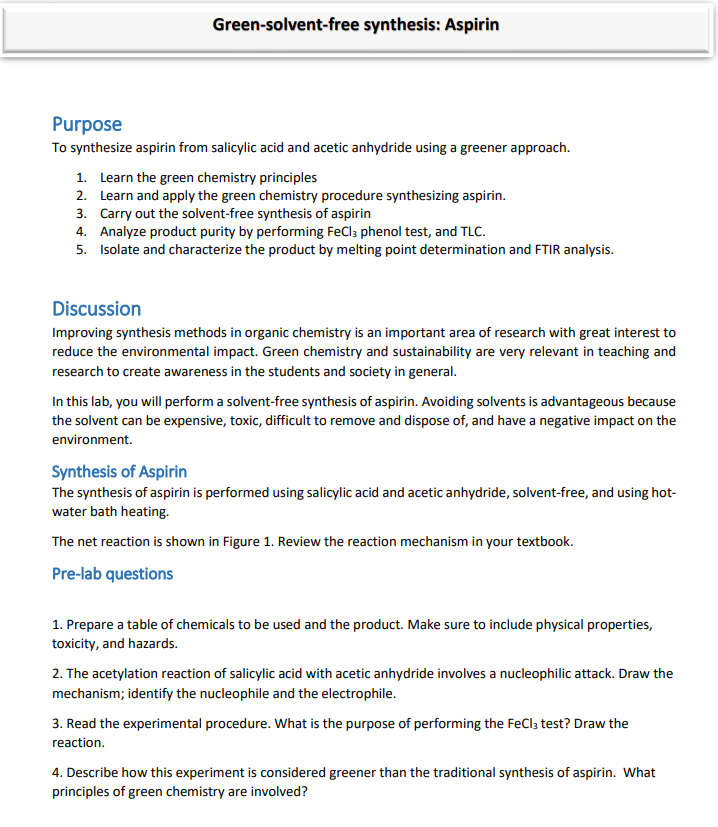
Solved Purpose To synthesize aspirin from salicylic acid and | Chegg.com
Source: chegg.com
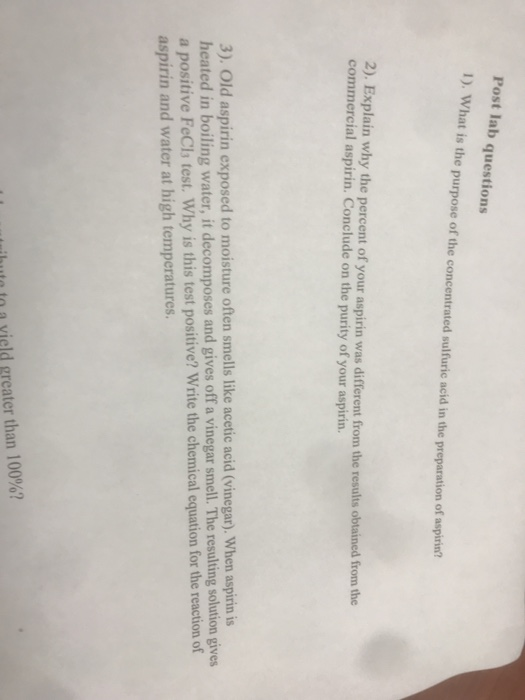
Solved Post lab questions 1). What is the purpose of the | Chegg.com
Source: chegg.com
CHEM 322: ESTERIFICATION REACTION Synthesis of Aspirin +

Source: studylib.net
What Is The Purpose Of The Text Aspirin, Daily Aspirin – Should You Take It Cardiologist explains., 6.61 MB, 04:49, 2,732,506, Talking With Docs, 2021-07-29T01:30:53.000000Z, 2, Solved Purpose To synthesize aspirin from salicylic acid and | Chegg.com, chegg.com, 827 x 718, jpg, , 3, what-is-the-purpose-of-the-text-aspirin
What Is The Purpose Of The Text Aspirin. WebRating: ★★★★. Jeffreys describes aspirin as, among other things, “the most remarkable drug the world has ever seen,” “one of the astonishing inventions in history,” and “one of the most endurably successful commercial products of all time.”.. WebAspirin and Patient Use Patterns: Are We Using it the Right Way? Aspirin has been commercially available for over a century and used for antithrombotic purposes nearly as.
Always check with your health care professional before taking any medications.
The surgeons would like to thank Dr. Mike Heffernan for discussing the question of whether or not to take daily aspirin (ASA). We discuss who should take daily ASA and who should not. We discuss the mechanism of action of ASA and how it can prevent heart attacks.
Here is the link to the paper from The Lancet
thelancet.com/article/S0140-6736(18)31924-X/fulltext
Please see the complete user agreement at talkingwithdocs.com
Medical emergency
Do NOT use the Video for medical emergencies. If you have a medical emergency, call a physician or qualified healthcare provider, or CALL 911 immediately. Under no circumstances should you attempt self-treatment based on anything you have seen or read on the Video.
General information is not medical advice
The general information provided on the Video is for informational purposes only and is not professional medical advice, diagnosis, treatment, or care, nor is it intended to be a substitute therefore. Always seek the advice of your physician or other qualified health provider properly licensed to practise medicine or general healthcare in your jurisdiction concerning any questions you may have regarding any information obtained from this Video and any medical condition you believe may be relevant to you or to someone else. Never disregard professional medical advice or delay in seeking it because of something you have read on this Video. Always consult with your physician or other qualified healthcare provider before embarking on a new treatment, diet, or fitness program. Information obtained on the Video is not exhaustive and does not cover all diseases, ailments, physical conditions, or their treatment.
Solved Purpose To synthesize aspirin from salicylic acid and | Chegg.com
Daily Aspirin – Should You Take It Cardiologist explains.

Source: Youtube.com
Aspirin – a good or bad idea

Source: Youtube.com
Aspirin: MedlinePlus Drug Information
Aspirin is also sometimes used to lower the risk of blood clots in patients who have artificial heart valves or certain other heart conditions and to prevent certain complications of pregnancy. tell your doctor and pharmacist if you are allergic to aspirin, other medications for pain or fever, tartrazine dye, or any other medications. tell your doctor and pharmacist what , .
.
Aspirin Oral: Uses, Side Effects, Interactions, Pictures, Warnings & Dosing – WebMD
Find patient medical information for aspirin oral on WebMD including its uses, side effects and safety, interactions, pictures, warnings and user ratings. .
What Is Aspirin and What Is It Used For? – Baptist Health
Acetylsalicylic acid, better known as aspirin, is widely used to relieve minor aches and pains, reduce fevers, thin the blood and decrease, .
Aspirin: Health benefits, uses, risks, and side effects
Aspirin helps relieve pain and swelling, and it may reduce the risk of more serious issues. Here, learn who may benefit, who should avoid it, and more. .
Aspirin Uses – Therapeutic Uses, Side Effects, Structure of Aspirin with VIdeos
Aspirin is used to treat pain, and reduce fever or inflammation. Aspirin or acetylsalicylic acid, having been in medicinal use for over 100 years, is perhaps the most widely used analgesic and antipyretic drug worldwide. .
Aspirin Uses, Dosage, Side Effects & Interactions – Drugs.com
It works by reducing substances in the body that cause pain, fever, and inflammation. Aspirin is used to treat mild to moderate pain, and also to reduce fever or inflammation. It is best taken with food and a glass of water. What’s the difference between aspirin and ibuprofen? .
The Chemistry of Aspirin | The International Aspirin Foundation
Aspirin is prepared by chemical synthesis from salicylic acid, through acetylation with acetic anhydride. The molecular weight of aspirin is 180.16g/mol. .
.
Aspirin: low dose to prevent heart attacks and stroke – NHS NHS medicines information on low-dose aspirin – what it’s used for, side effects, dosage and who can take it. .
Aspirin – Tests & treatments | NHS inform
Aspirin is a common medicine that has a number of uses, from relieving pain to reducing the risk of heart attacks and strokes. .
Is Taking Aspirin Good for Your Heart? | Johns Hopkins Medicine
Just because you can buy aspirin without a prescription doesn’t mean it’s without risks. Taking it to prevent a heart attack could be harmful. Find out why. .
Aspirin: Uses, Interactions, Mechanism of Action | DrugBank Online
Aspirin is a salicylate used to treat pain, fever, inflammation, migraines, and reducing the risk of major adverse cardiovascular events. .
Daily aspirin therapy: Understand the benefits and risks – Mayo Clinic
Daily aspirin therapy may be lifesaving for some people. Know if taking a daily low-dose aspirin is right for you. .
Salicylic Acid (Aspirin) – StatPearls – NCBI Bookshelf
Salicylates have been available since the early 1900s. This activity outlines the indications, mechanism of action, methods of administration, important adverse effects, contraindications, and monitoring, of salicylic acid, so providers can direct patient therapy in treating indicated conditions , .
Aspirin for Reducing Your Risk of Heart Attack and Stroke: Know the Facts | FDA
Information on using aspirin daily, over-the-counter, with other medicines, as well as its side effects .
Aspirin – Wikipedia
Aspirin is also used long-term to help prevent further heart attacks, ischaemic strokes, and blood clots in people at high risk. For pain or fever, effects typically begin within 30 minutes. Aspirin works similarly to other NSAIDs but also suppresses the normal functioning of platelets. .
Aspirin: Uses, Warnings & Interactions
Aspirin is a type of NSAID that can treat mild to moderate pain and inflammation. It also lowers your risk of heart attack, stroke or blood clot. .
Aspirin – Asprin
Aspirin (acetylsalicylic acid) is a pharmaceutical drug used to reduce pain or inflammation. It is classified as a non-steroidal anti-inflammatory drug (NSAID). .


 used to reduce pain, fever, and/or inflamm...)
Post a Comment